
Cool Mom
On Coming Out Late, The Infinity Loop of Radical Parenting & Why Pride is Always a Riot

“Where’s Hellie?” Asks my oldest, pulling on the corner of my shirt, the edge of fear in their voice. I turn from the distant churning bodies of Seattle Pride, towards two upturned faces where there should be three. The world is a pinpoint. The panic as clear and concentrated as a nail through a bare foot. “WHERE IS HELLIE.” The street is a wall of people in rainbow capes, booty shorts and movie-sized sunglasses. It’s a sea of burning skin and delighted screeches. My youngest child is so gone, it’s like a wind whipping through my chest.
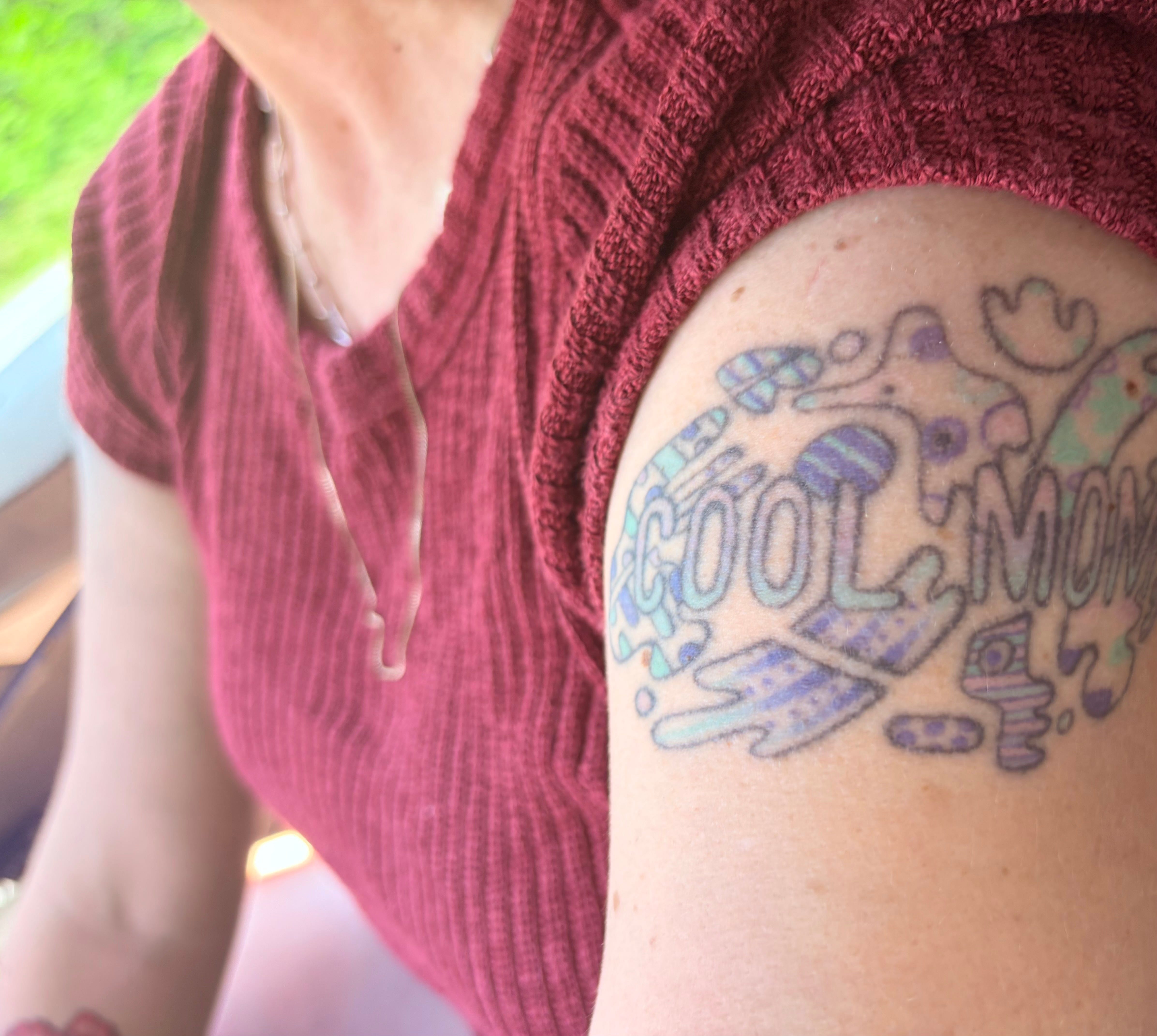
“Love the Cool Mom,” remarks a young queer selling Pokémon-themed pronoun bracelets, an hour earlier, pointing at my left bicep. I look down my arm, which is clearly burning in the dusty heat, the tattoo practically fading before my very eyes. “Ha! Thanks!” I say smiling a smile I can’t quite keep on this side of embarrassment.
It was designed by an artist friend when I was still nursing my youngest. It was meant to commemorate my transition into parenting and to celebrate the growth of a chosen family to include children. I got “Cool Mom,” along with a childhood best friend who had also just become a parent. Two other friends got “Cool Aunt.” The turquoise and purple, neon, squiggly motif, cheerfully suggests our membership as elderly Millennials
When I got it, I liked the taboo of a tattoo on a new mother. And I liked the riff on two white, middle-class mom archetypes. The sexless “uncool mom” who becomes elderly at forty and subjugates her life for her kids. Or the “cool mom,” who refuses to mature into middle age, flirts with her children’s friends and lets everyone drink in the basement. It was funny because misogyny is funny. It was funny because, obviously, I would gracefully avoid both stereotypes and probably not age.
The kids I’m with today are a squawking chorus of demands for food, drinks, shade, money, and attention. Their six hands are simultaneously pulling on every sector of my body, like the community resource it so often is.
I have the sinking feeling I often get when I realize I’ve exercised poor judgment regarding what will be fun with the kids. They don’t want to be at Pride, I do. You can tell by my outfit—the short shorts and careful make-up of a woman going to flirt over vodka tonics, not toting around wet wipes, three water bottles, and 40 packages of fruit snacks.
But I have spent decades not going to Pride. I didn’t come out until 6 years ago, and I want the feeling of being gay among gay people. The spectacle. The unmasking. The belonging. But of course, I don’t really belong. I’m a gay mother. A gay mother with a husband. We don’t really have a flag.
“Always a day late and a dollar short,” My mom used to say out of frustration for missing the mark in life. She is full of folksy sayings that have somehow survived the journey from Kentucky to Seattle. This is one of my favorites.
I have the deepening realization that I vaguely know this bracelet vendor. I have been circling the periphery of queer activists ever since my arrest at a protest for Palestine. Full of false promises to make it to a meeting that doesn’t quite fit between my last therapy client and after-school pick up.
I don’t know these folks well, but they are kind. They are friendly.
Still, I feel their younger, childfree, unquestionable queer, artistic, radical, and brilliant eyes upon me. None of them has seen me like this. In the low-level, reactive chaos of parenting. The sweaty embarrassment of it. The raw performance. The intimate display.
Many of them were probably here at this park last month, when Christo-Fascists came to “pray the gay away,” and police turned their pepper spray and automatic violence on the neighborhood’s residents, as they always do in this city. Those same cops are here at Pride, just beyond the cluster of vendors. But this time with rainbow patches on their shoulders.
I will never be young and gay and angry. By the time I came out, I was middle-aged and staggering under the weight of the choices I had made (parenthood, marriage, graduate school to become a therapist). And some choices that had been made for me (my husband’s infidelity, work to pay the bills, a pandemic). “Young” may be out of the question, but “gay” and “angry” are still very much on the table. So, when the cops started throwing batons at trans people a mile from my house, I was hungry to be there.
I like to riot. I got my first taste as an anti-globalization protestor during the World Trade Organization’s failed meeting in downtown Seattle in 1999. I was nineteen and a white kid from Seattle’s North End. I’d never experienced police violence or the impact of collective power. But as the tear gas bloomed and armored vehicles patrolled downtown, as strangers flushed my eyes with water and linked arms with me to stop people in power, something changed in me that never changed back. It proved that something else was always possible if you could envision it with others and trust each other to get there.
But rioting at my age is unbecoming. My version of a middle-aged man in the mosh pit or dating a woman in her twenties. So instead, I’m usually packing lunches and following social media with the white knuckles of a recovering addict—In a roiling world full of temptation.
Back at Pride, I am trying to pay for 3 different (and wildly inconsistent) pronoun bracelets with Venmo, but my credit card has been declined or has expired. A rivulet of sweat tickles the inside of my arm, and I wipe it away on a tank top decorated with a collection of political buttons. I have an IUD, so I haven’t bled in years, but I have a brief flash of panic that a period stain is spreading on the back of my mauve shorts.
Change falls out of my wallet onto the baking pavement. My daughter is no longer at my side. I experience the quick lightning bolt of fear that has been a feature of raising a child who acts like someday she might just amble off in any situation and find a new family, like an alley cat always on the prowl for something a little better.
My youngest has taught me a whole new kind of fear. The fear of losing her. Once she could walk, she could climb to the top of the play structure, bolt into the street, and wander into a random open door. There was no option but total vigilance, and even then, with my nervous system on full alert, she flummoxed me.
At her older sibling’s fourth birthday, we took the kids and a few friends to the top of the Space Needle—a place I hadn’t been since my own tenth birthday. The views from the top, now accessible via a clear floor, were dizzying. And I fought for my good nature to win over my nerves. I stopped myself from telling the children to step back from the edge. It was perfectly safe. Millions of others had stood exactly here and survived.
Back at the bottom, Alex ran to get the car, and Hellie toddled after him. “Hellie’s behind you,” I shouted as he raised his hand and waved at me. I stood in the bright cold listening to the Peruvian pan flutes that are ubiquitous in public spaces in Seattle and watched my oldest and friends bat a balloon around. I remember I was worried there wouldn’t be enough cake back at the house, and also, that maybe I should have provided lunch. I remember thinking that someone should have taught me how to throw a kid’s birthday. Why would something so banal feel like starting from scratch every time?
Soon enough, Alex jogs back cheerily with the car keys rattling from his hand. “Ready to go, everybody?” He asked and then, with a widening of his eyes, “Wait. Where’s Hellie?”
“With you!” I scream. Already aware that it’s an emergency, “With you!” Every cell was on fire. How long has she been gone, with neither of us knowing? At least 15 minutes, maybe longer. I’m running and yelling toward the direction I’d last seen her. The bargaining with God is immediate and raw and basically sounds like “Please just kill me instead of this.” But before he does, a woman in what I assume is traditional Peruvian dress grabs my arm: “Are you looking for a little girl?” she asks and then answers, “I found her. She’s dancing to the music.”
And there she was, at the center of the Peruvian panpipers, antennae pigtails bobbing up and down with each bend of her fat toddler legs. Not a whisper of concern on her face. “We thought she was here with someone watching the music,” explained the woman. “But then everyone left, and she was still here. We think she wants to join the band.”
Today, six years later, my shoulders drop a few inches when I spot her accepting a snow cone from a vendor a few feet away that, it turns out, does not accept cash.
My oldest is mortified at my flustered inability to pay everyone efficiently and at the same time. Their pre-teen eye roll takes in a sweeping view of the entire, disgusting universe. “You promised me ice cream!” my oldest shouts at me, like a caricature of a misbehaving child in a Roald Dahl book. They stomp off towards the middle distance. My goddaughter runs after them but stops long enough to throw a tiny middle figure up at the swarm of rainbow-washed cops.
I want to scream at all three of them at the top of my lungs: GET THE FUCK BACK HERE. LINE UP BEHIND ME AND SHUT YOUR MOUTHS. YOU’RE EMBARASSING ME, AND THIS IS NOT SAFE.
But that would be even more embarrassing under the gaze of these curious activists. Mothers are either authoritarian or weak. I am just tired, and we’ve only been here twenty minutes. I want to go home and look at my phone in a dark room. Instead, I make urgent promises to come back soon with cash for everyone and jog towards the cops, my daughter and her melting treat trailing behind me.
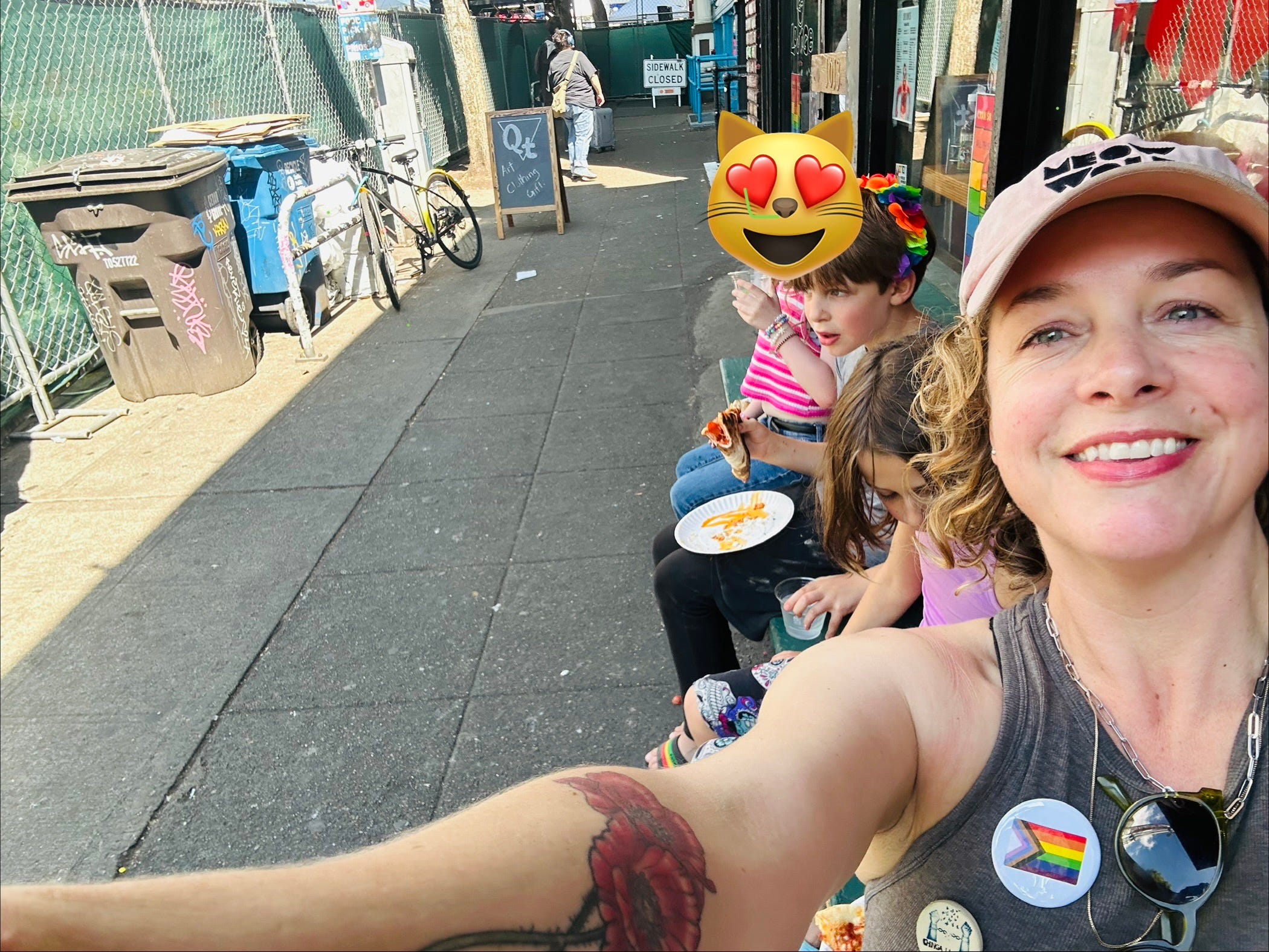
“Honey! Honey!” I shout at my goddaughter, who is now using both middle fingers and doing a little hip swaying dance of mockery towards the cops. I slow down a little, realizing I will have to come up with the right thing to say by the time I reach them.
Because I am a “Cool Mom,” earlier in the day, I had been explaining to the kids that the first Pride was a riot against anti-gay laws and police raids in gay bars in New York City. At the time, it had seemed of no interest whatsoever to them. But clearly, it has made an impression on at least one.
Seattle Pride is located a few blocks away from the police precinct that was overtaken by protestors in the George Floyd Uprisings in 2020. Seattle police, who have been under a Consent Decree for decades due to their racist policing, corruption, and violence, are thoroughly hated by the city. The police at this precinct (some of whom were later determined to have been at the January 6th attempted coup) are particularly loathed.
This little square mile of the city is the neighborhood chosen by Seattle to be the official, dysfunctional town square. A microcosm of every rebellion, challenge, and heartbreaking failure the country has on offer.
None of the gays out today are going to mind that my kid is taunting these police officers. But a muscular man in a tank top and cutoffs does stop, amused, to see what I’m going to do about it.
There is, it seems, no end to all of the ways I don’t know how to raise kids.
When they were babies, I just didn’t know how to feed them, get them to sleep, stop their crying, teach them to crawl, or help them build secure attachment.
Now I don’t know how to raise white children with privilege in a world this unhinged. I don’t know how to teach them to be brave without traumatizing them. I don’t know how to instruct them without making it a performance. Or how to cultivate patience, that isn’t just some version of me silently screaming inside. I don’t know how to be a full, complex human being that also shows them they are beloved, seen, and centered.
My goddaughter is looking over her shoulder at me, sure that I’ll be proud of her. Her little freckly face a hilarious contrast to the scowling police in front of her. Her hair is the color of the sun-bleached grass. My oldest is standing next to her, but is concerned. Their sassy bravado dampened by the possibility of getting in Real Trouble. Something they fear, maybe in part because I am an unreliable predictor of what might provoke Real Trouble. My daughter is petting a poodle with her popsicle hands, halfway across the field.
“OK, OK. Get over here, everyone. It’s ice cream time,” I say, herding them a few feet away and out of earshot of the police and observer before launching into my hasty analysis. Hellie begins a long saunter over, and the four of us walk slowly, heads bent in the punishing heat.
“Look. I will absolutely defend your right to flip off the cops if you want to do it. I just want you to know that the cops, or other people, might say something about it. It’s not, you know, a neutral act. Not everyone is going to think it’s cool and cute, and you can only really get away with it because you’re all white…”
I’m trailing off.
“What’s neutral?” asks the 8-year-old.
“Can we get arrested for it?” asks the 9-year-old.
“What is queer again?” asks the 7-year-old.
Thankfully, the ice cream shop is coming into view. As I watch the three of them race ahead of me, I can see their future teenage selves. The big sweatshirts, the dyed hair, the baby-faced contempt, and the growing realization that I don’t have that great of answers…for anything. When they were babies and people would tell me, “Enjoy, it goes so fast,” I had to bite my tongue from saying, “Time is moving backwards. I am scratching each day off on the wall of a prison cell.” Now I see what they meant. Time is scrolling hastily towards an uncertain destination.
I had post-partum depression with my first. Becoming a mother coincided with the end of my career as a journalist. I lost my contract at the university while I was six months pregnant. I lost my column at the newspaper nine months into parenthood. Journalism had been the profession and identity that had shaped my life through my twenties and the first half of my thirties. I had no idea who I was without it.
I don’t spend a lot of time thinking about those early years. They are filed under, “I got through them and we’re somewhere else now.”
But then we had to move the couch last week.
It has been the mushroom-colored, IKEA-bought, L-shaped, fluid-stained centerpiece of our lives for a decade. We’re junking it in favor of something bigger, newer and more expensive. Our new place will be a house, not an apartment.
I have tried to make a point of not being sentimental about furniture or things. My parents were antique dealers, and I grew up in a house where every item was imbued with so much meaning it was hard to breathe. I’d been packing up our apartment with mechanical efficiency. There is a time for feelings. Sweating over boxes of half-broken toys is not the time.
But pulling the couch away from the wall aims a sun beam on a secret midden: faded, yellow, potato chip bags, hairballs of now-dead cats, a medley of Legos and goldfish crackers. And one tiny baby sock—green and gray striped. It is the size of a dollar bill folded in half. I remember this sock. It’s not a friend’s child’s sock. It’s not even my youngest’s sock. It’s my eldest’s. This sock has been lying in wait for this moment for 9 years. And it’s bringing the pain of pent-up patience.
I place it in the flat palm of my hand. I sit down on cushions that are a map of every pee stain, jostled coffee, and greasy hand. How many times have I turned these cushions in hope of a fresh start? A constant rotating out of new, unbearable problems for the older ones we’d misplaced. The nights that Alex and I sat arguing on this couch—him on the second cushion, me perched on the arm nearest the dining room. The time he told me he was in love with someone else. The pandemic-style Zoom therapy we did, hugging disintegrating pillows, afterward. The scheming on how we might open our relationship and turn another cushion.
And before all of that, the era of the tiny sock. The sleepless nights, the leaking breastmilk, the days when I didn’t leave the couch because I absolutely couldn’t. Baby feet so small I could barely stand to look at their delicacy.
A few months into parenting, I woke up for the third time to nurse. My big breasts were always full of milk, and my big baby was always voracious. But the two of us could just not get our shit together. They were hungry, and I was tired. My boobs ached, and they were sleepy. They would clamp down too hard on my battered nipples, and I would pull them off. Or hilariously (in retrospect) they wouldn’t clamp down hard enough an urgent stream of milk would shoot them in the face, sending them on a crying jag. What’s worse, there were always people around witnessing my failure to fulfill this basic, biological function because I was trying not to be weird about breastfeeding in public.
The night my spirit broke, my new baby and I had, yet again, failed to connect hunger to nourishment. They lay sprawled on my lap, wailing with the intensity I now realize is core to their character. We were both hot and furious. And the voice that cut through it all was loud, clear and cruel.
“You’ve ruined your life,” it said emotionlessly.
“The sooner you accept it, the easier it’ll be.”
An onslaught of images pulled my hands to my red face.
Waking up for the first time in a new country. How the light of dawn is the same everywhere, but the smells are so different. Alex and I at a bar. His camera on the table next to my notebook. Napping to monsoon rains outside an open window. Newspaper clippings with my byline spread on my Mom’s dining room table. The radio through the shower steam. Rivers of protestors flowing below a rooftop in Moscow.
And then the final months of my pregnancy, big and pulling myself across the shale rock of a valley in Denali trying to beat a thunderstorm. Giant and gagging with a microphone in my hand beside a fish processing line. Laughing at myself. Laughing with my fellow journalists as they snap photos.
No more cushions to flip on this thing. I’d do anything to hold that baby on this couch again. And I’d rather die than go back there. The infinity loop of longing that is parenting is a stone pushed down my throat.
“MOM. THIS ICE CREAM SHOP IS ZIONIST.” declares my ten-year-old before a startled line snaking out the door.
“Is it??” asks someone leaning out with concern.
“I don’t actually know,” I respond. Turning to my phone for a furious google. I can’t tell if my oldest is weaponizing my politics against me in a way that I should try and soften, or if they are expressing their own politics in a way I should encourage. My phone is not loading.
“You DO know that it is,” shouts my kid, “I TOLD you that someone at school TOLD me.”
Goddammit.
This is what I get for trying to raise them as a political accessory. It’s as though I’m always a few years behind the maturity required to successfully parent the kids at whatever stage they are in. Everything is revealed through retrospection—long after you can correct course.
I very briefly, and unceremoniously, returned to journalism for a few months in 2020. The kids were 2 and 4 and the pandemic was in full swing. Alex and I were both in graduate school, working and, I realize now, unhappy. It was the first time I noticed how small that apartment really was.
He wanted to date women and so did I, alongside the men I couldn’t seem to help but swipe on. But dating didn’t give me what it gave Alex. Where he found escape, I found fear. Where he found love I found panic. It wasn’t an adventure; it was a relentless emotional excavation.
And then the George Floyd Uprising came to Seattle. I was vibrating with fury. The violent, racist, profanity of the system was on full, unapologetic display. I could have pulled apart that police station with my bare hands. Instead, I begged a babysitter from the Covid pod, put a pen in my ponytail and headed to the newly declared, protestor-controlled, autonomous zone. An Autonomous Zone that was, for the record, on the same block as this very expensive, possibly Zionist ice cream shop.
When I arrived, people were on the move and the crackling in the air stood the hair up on my arms. Something was happening. You can always tell. I swept down the street to an under-construction youth jail with a river of black-clad protestors. Suddenly, a barricade of black umbrellas bloomed, and a few people nimbly spraypainted the lens’ of nearby security cameras.
I smelled the fireworks before I heard them. Big ones, blowing up the construction portables at the intended site of the youth jail. A fire caught quickly, an orange scrim against the bright blue sky. It grew alongside a roar from the crowd that I felt in the bottom of my gut.
I went there almost every day after that. Often with my kids in a big, red, double jogging stroller that I never once used for jogging. I did some reporting for a non-profit, online publication. Me interviewing hot dog vendors and recording impromptu megaphone speeches while the kids, wide-eyed, ate free donuts.
I wanted them to soak it all into their little sponge brains. The chaotic, messy liberation of it. The chaotic, messy, failures. But I also wanted it for me. I wanted to be in the middle of things that felt meaningful again. And, despite the shame this provoked in me, at that time, raising kids did not provide that meaning.
But then, years later, as the genocide in Gaza intensified it was being a parent that activated me. By April of 2024 I couldn’t stand watching another mother sob over the limp body of her child without doing something to publicly express my rage. No one was rioting, but they were putting their bodies on the line. I called a friend, a queer mom who was more involved in activism. “Next time someone is ‘doing something.’” Let me know. I’ll just drop everything and join. I can’t take this anymore.”
Within a few weeks I was standing on a freeway blocking the entrance to the airport with zip ties cutting into my wrists and bystanders screaming at me that I was an antisemite. My children, at home with one of their “cool aunties,” watching me on the evening news.
There was a phone in the holding cell for you to call family or lawyers on, collect. I talked to my kids as a dozen other arrestees listened from the cold, narrow benches.
“Yes, I’m in jail. I’m ok. I’m here with my friends. Are you ok? Are you in bed?”
“You want to hear the other people here? They all say ‘Hi.’”
“Yes, I’ll tell them you said, “Free Palestine.”
“Haha. Yes, they like it that you said that.”
Despite the exhaustion and fear of that moment. I remember feeling really proud of being a parent. I was there, not despite my status as a mother but because of it.
Now, standing in front of the ice cream store trying to research whether or not it is on a boycott list while a small audience of observers tap their toes, I am feeling some payback. Today it is in my eldest’s stridency. I often wonder if a little further down the line it will come in the form of backlash.
We talk a lot about the innocence of children. But I think also, parents must be innocent to engage in the impossible work of our daily lives. It requires a cognitive dissonance that allows us to believe that we will be the exceptional generation that isn’t just correcting for the gaps and failures of our own childhood. And yet, despite my psychoanalytic tendencies, I try to resist the cynicism that suggests that every radical belief system is just a latent desire to shock one’s parents.
The ice cream plan is shot and we’re headed for pizza instead. But we’re passing by a club hosting a day-time party. The windows are huge, the music chest thumping even from here and the churning bodies irresistible. All three kids have their faces pressed against the glass and they are shouting out the names of people they recognize. Their aunties and auntie’s girlfriends are there. These are the “Cool Aunts” who didn’t have biological children but are regular caregivers and mentors to mine. My youngest is pressing her butt against the glass and attempting to “twerk” in a mechanical gesture that has more to do with moving her chest frantically than her butt. We’re getting attention as dancers turn towards the daylight and wave. I wave back too, aware of the metaphor. Mom on the outside of the club looking in, instinctually worrying that they are dehydrated. I hope I look good in my shorts. I suck in my gut—pillowy from past pregnancies.
Do I want to be in there? Not sure. I was never much for clubs even when I would have had the age-appropriate energy for it. But back then it was easy to dismiss clubs and partying as kind of distasteful—beneath me. But that was the straight version of partying. Clubbing and gay bars and are so essential to gay community and identity. If I had a wish, it’s less that I could ditch the kids and be in there now—it’s more that I could go back and be in there twenty years ago. To have had the opportunity to grow up inside a queer identity. To have another version of me—one that had the fucking guts to be gay before I was a middle-aged parent.
This is a source of deep frustration to me. I am a therapist and so I am basically in the business of helping people cultivate self-compassion towards themselves, often younger selves. But the other people I know who came out later in life didn’t grow up in Seattle in the 1990s. Didn’t grow up inside a family business that was—no kidding—located in the heart of this very gay neighborhood. In fact, is four blocks away from the daytime club I’m sweating in front of.
I tell myself my parents were homophobic (true). I tell myself that bisexuality was an invisible identity (true). I tell myself that pansexuality didn’t have a word yet (also true). I tell myself that I am raising children who will never even have to “come out” because queerness and gender nonconformity and experimentation will be the norm (I hope this is true). But there is an angry whine that sometimes cuts through all of these thoughtful justifications. A whine that simply sounds like but what about me????
Why can’t I be the kid whose parents encouraged and fostered their queer identity? Why couldn’t I have the fortitude to know who I was younger—instead decades conscripted and brutalized by the male gaze? At the very least, why can’t I be one of the childless aunties gleefully going back for their teenage selves? Kissing each other in the afternoon, across the bulge of neon fanny packs?
It’s so unseemly, this jealousy. I am lucky in ways that would need a scroll to list—but also even in the way of coming out at forty. Of being able to have an open marriage. Of getting to worry about the best way to help my kids explore gender instead of how I might get them fed. Still. It’s a hot little cord that pulls through my gut when it wants to.
I have a therapist supervisor who reminds me constantly that life is as much about grief as it is about anything else. That we can only experience love and presence in measure with how much grief and loss we are able to tolerate at the same time. We grieve versions of ourselves we will never know. We grieve lifetimes that are already too short for all we yearn to experience. We grieve knowing that every love story—even the sweetest ones—ends in loss. And we grieve knowing these griefs are still privileged grief in a world this mean.
“Where’s Hellie?” Asks my oldest, pulling my shirt, the edge of fear in their voice.
“HELLIE!!” I scream, dragging the other two by their hands. “Have you seen a little girl?” I ask a street vendor who shakes his head with shared worry. I push towards a bench and stand up on it, hoping a different perspective will give me a clue of what to do. I don’t even know which way to start looking for her. I see even less hope in a swelling crowd of aimless bodies milling in every direction.
I run back to the club window and try to catch the attention of the aunties inside, but they are long gone, somewhere behind the rattling glass. Another music event has kicked off in a tent about a half a block up. There are cute, young gays in halter tops pouring through entrance. I am desperate and feel like I’m spinning a place. I reach for my phone, muttering reflexively to the other two, “It’s ok. It’s going to be ok. We’ll find her. She’s here somewhere.” My hands are shaking wildly. Who do I call? The police? Their precinct is right there. Do I just walk up?
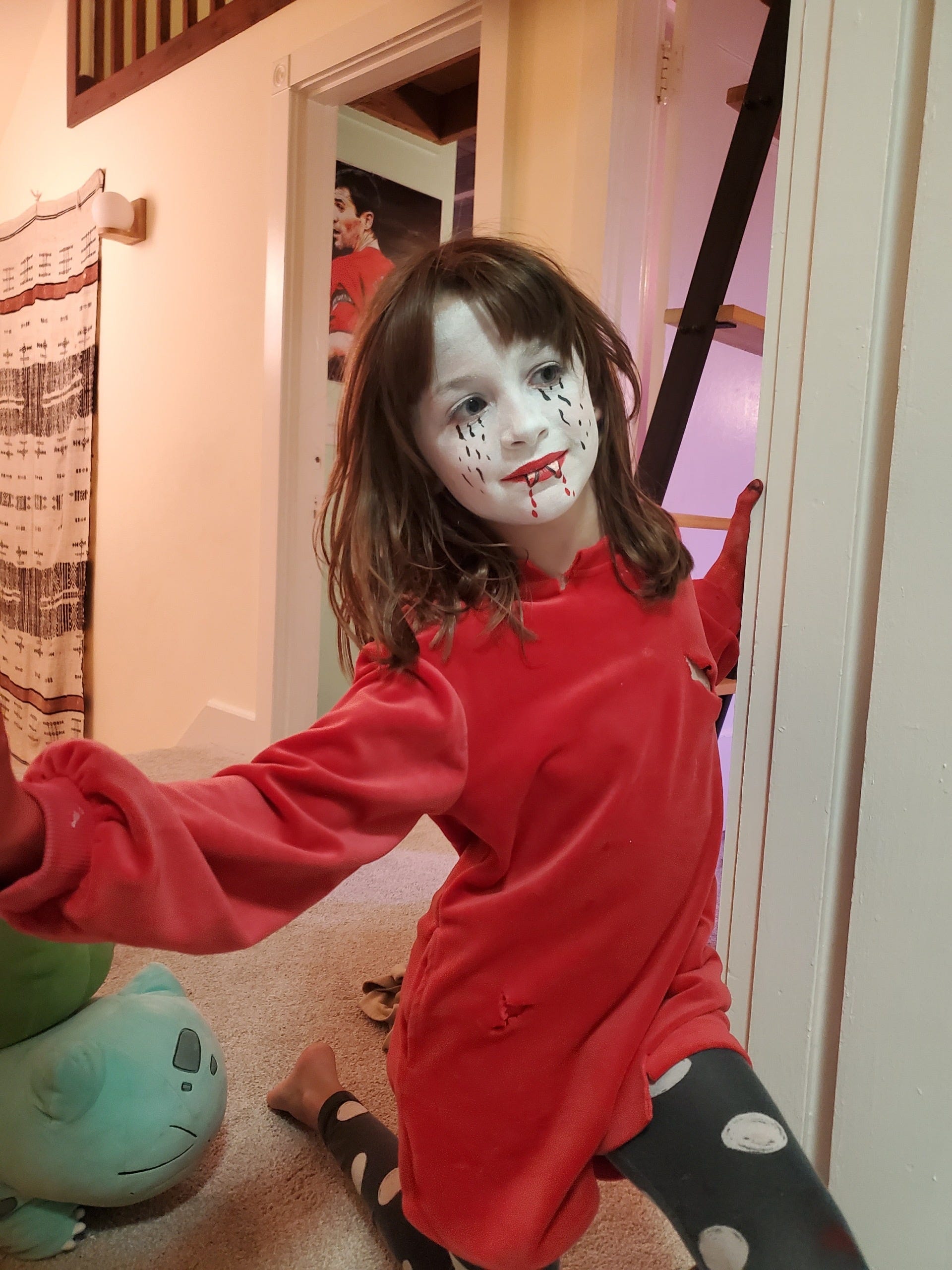
How will the police even begin to find a willow of an 8-year-old in a crowd like this? How could a person even begin to describe her laughing eyes and crowded teeth? Her uneven, self-given haircut, riot grrl tantrums and notebooks full of animated fruit comics? How could a mother ever let go of the thin, sweaty hand of a person that precious?
I hear the opening chords of the band in the tent, set up right outside of Seattle’s only lesbian bar. The crowd is screaming with excitement and my eyes follow the last few concert goers, hand in hand run up with excitement.
In an instant I know where Hellie is.
“Stay here on this bench and DO.NOT.MOVE.” I tell the other two whose eyes are filling up with tears. “I’m going to get her back right now.”
Approaching the tent the bouncer clocks me. “Sorry Ma’am, you need a ticket,” he says putting up two hands to slow me down.
“I know. I know. It’s just I think my daughter snuck in here and I’m looking for her and I’m really worried.”
His harsh look softens to an almost smile. I can hear his thoughts:
“Lady, I think there are a lot of daughters in there today.”
I peer through the flap toward the stage where a singer with a shaved head and a bikini top under a denim vest is performing for ecstatic dancers.
“Oh. No. My daughter is eight,” I try to explain again. “She’s not a teenager, she’s like missing…”
And there she is, front and center. Worshiping eyes turned upward toward the stage, tiny booty sticking out mid signature-twerk.
A young woman with a ticket recognizes my predicament and heads towards Hellie, who puts up some resistance that seems to have more to do with not wanting to leave, then following the instructions of a stranger.
“Here you go,” the young woman says ushering Hellie by her sunburnt shoulders through the tent door and into my arms. Then adds with a wink, “Seems like she’s having a great Pride.”
And as I kneel on the cigarette strewn sidewalk and look Hellie in her delighted face, I think of all the times she will disappear from my view. I feel the deep gravity of seeing her full personhood unfurling before me. I will try and keep her safe while I can. I will try and teach her about being kind and furious and suspicious of power while I can. I will try and teach her about being brave and also sensitive while I can. But in the end, in ways I can predict and others I can’t predict, I will lose Hellie and Hellie will lose me again and again. And it will hurt terribly. And my ability to know that, while also staying with her as deeply and as clear-eyed as I can, is what radical politics and radical parenting often have in common.
Radicals love the world with a passion that believes in a dynamic and beautiful future that may or may not include them. Queers believe in the changeable, inventive nature of human experience. Something that can’t be easily categorized or comfortably explained. And parents love and care for people so, under the best of circumstances, they can leave them and inhabit lives that may be illegible to us, or absent of us. We love so that these complex kids whose care we’ve been entrusted with can enter an often-brutal world and love and grieve on their own terms.
Radicalness, queerness and radical parenting are all about depth, expansiveness and imperfection. In them we expand to hold the past, present and future at once. The humility and mercurial nature of it all. The possibility of not just everything that can go wrong all the horrible futures to avoid. But the belief in a beautiful one yet visualized. One you may never see. One that started in a great great great grandmother and moves through you towards a great grandchild you will never know. In-between it all is the presence to now. The sweaty, unknown, yearning and wonder in a single ill-conceived afternoon out with your kids.
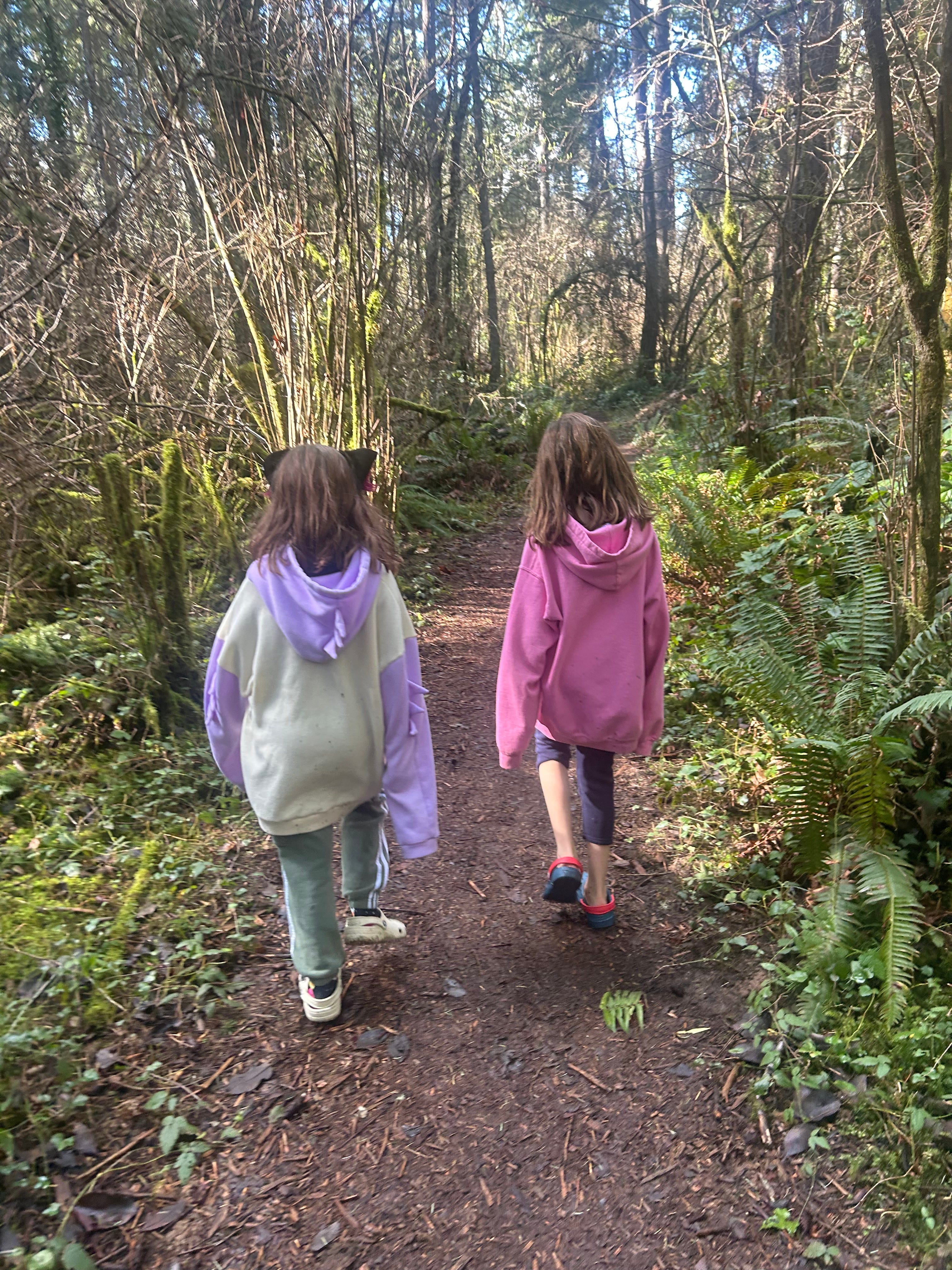
And in the midst of this there is being a “Mother,” that sacred punchline of a word. I am smothered, hardened, shaped and softened by it every day. It starts with pounding on the bedroom door and ends on the bottom bunk watching (on silent) videos of mothers being violently separated from their children by ICE agents.
It makes me crazy. It keeps me from everything I want to do. It is time passing before my eyes. It is all the people I won’t fuck, all the books I won’t write, all the clubs I won’t make out in, all the riots I can’t rush downtown for. And it’s the reason I want to do anything, fuck, write or riot. It is the urgency of the world, of this moment and the very shape of the preciousness of time.
The four of us half crawling to the car after frantically paying the snow cone vendor and studiously avoiding the cool activists, we collapse under a tree on a parking strip drinking bottled water and arguing about whether or not I have to give them all piggyback rides to the car some three blocks away. As I pass out packages of gummies and shout, “NO. YOU CAN WALK THREE BLOCKS.” Two queens pass and laugh warmly at our distress. “Too much partying huh, Cool Mom?” asks one, winking towards my tattoo.
Hellie was stressing me out lol. Bring her by for art some time this summer. There is a lot to unpack here. I hope you'll keep talking about this. <3
There are so many relatable moments in this piece (the quiet desperation of parenting, hanging in there when we are completely overstimulated, the desire to belong to a group when you don’t look like you do, being weighted down by our choices / discovering ourselves in midlife) — along with so many moments that tell the story of what makes you you. You rioter. I loved it. I hope the youngins who read it realize that we can still claim being our full selves as we age and experience new life phases. 🫂